
ExoQuick Exosome Precipitation Solution
Isolate high-quality exosomes fast and scalable from plasma, serum, and ascites fluid
| Specifications | |
|---|---|
| Product Category: | Exosome Precipitation |
| Sample Type: | Plasma/Serum |
Product Description
The ExoQuick® isolation kit enables high-throughput, high-yield exosome isolation. Using this proprietary, polymer-based reagent, exosomal vesicles are gently and reliably precipitated from solution. Compatible with plasma, serum, and malignant ascites, and a wide variety of downstream applications, ExoQuick is an effective and proven alternative to ultracentrifugation.
With a simple workflow involving minimal hands-on time and low input sample volume requirements, ExoQuick is an excellent option for researchers who need to purify multiple exosome samples and/or samples from small animal models or clinical research samples.
To isolate exosomes from plasma, we recommend pre-treatment with the Thrombin Plasma Prep or using the ExoQuick™ Plasma Prep and Exosome Precipitation Kit.
Features and Benefits
- Saves time and labor
- Is easily scalable
- Conserves precious sample
- Delivers high yields of functional, high quality exosomes
- Isolate exosomes for a wide range of downstream applications
Questions?
Connect with us today to get started with your exosome isolation.
Applications
- Biomarker studies
- Exosomal miRNA profiling
- Exosomal proteomics and lipidomics/metabolomics
- Functional studies, such as in cell-to-cell signaling, basic biology, such as role in tumorigenesis
How it works
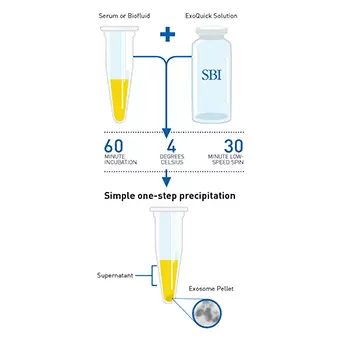
Add the appropriate amount of ExoQuick to your cleared biofluid, refrigerate, and centrifuge (see the product manual for protocol details). Your exosomes will be in the pellet, ready for resuspension in an appropriate solution.
To isolate exosomes from cleared serum, plasma, or ascites fluid, simply:
- Add an appropriate volume of ExoQuick to as little as 100 µl sample
- Incubate for at least one hour at 4°C
- Isolate exosomes with a 30-minute low-speed spin (1500 g).
Choose the right ExoQuick for your application
| Application | Product |
| Purest EV isolation | ExoQuick ULTRA ExoQuick-TC ULTRA |
| General purpose EV isolation | ExoQuick ExoQuick-TC |
| EV isolation that removes contaminating lipoprotein particles from plasma or serum | ExoQuick-LP |
| EV isolation that includes a de-fibrinating plasma step prior to isolation | ExoQuick Plasma Prep with Thrombin |
Supporting Data
Use ExoQuick to isolate exosomes for proteomics and miRNA profiling studies
Exosomes were isolated from ovarian tumor ascites fluid using ExoQuick, chromatography, DynaBeads, or ultracentrifugation. The ExoQuick method consistently delivered higher concentrations of protein than the other three isolation methods used (Figure 2).
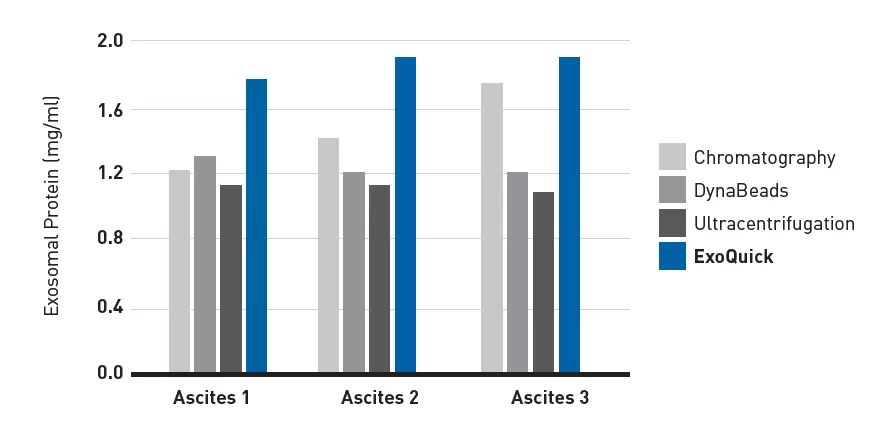
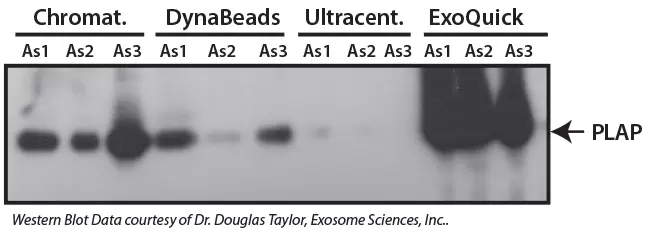
Figure 2. (Top panel) Exosomal proteins were extracted from recovered exosomes, and the amount of protein determined by the Bradford microassay method (Bio-Rad Laboratories), using BSA as a standard. Proteins from each exosome isolate were standardized to the original sample volume and equal volumes were applied per lane of a 12.5% SDS-PAGE gel.
(Bottom panel) Western Blotting was performed to analyze the presence of the specific marker protein, placental alkaline phosphatase (PLAP). The bound immune complexes were visualized by enhanced chemiluminescence (ECL, Amersham Life Sciences) and quantitated by densitometry (Un-Scan-it Software, Silk Scientific Corp.).
ExoQuick supports high exosomal miRNA yields
Exosomal microRNAs were recovered from ovarian tumor ascites fluid using either ExoQuick isolation of exosomes followed by Trizol extraction of RNA, Trizol extraction of ovarian tumor ascites fluid with no exosome isolation, or exosome purification using DynaBeads followed by Trizol extraction of RNA. The samples where exosomes were purified using ExoQuick showed the highest yields of microRNAs (Figure 3).
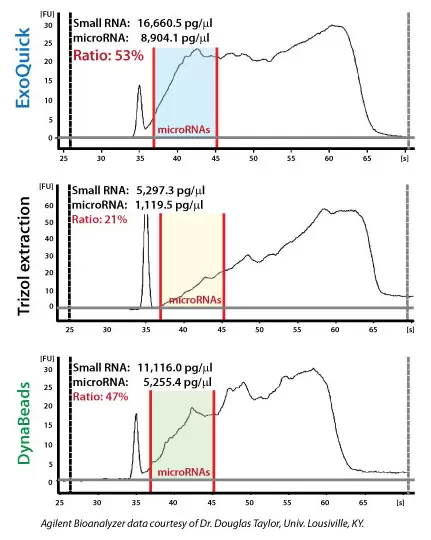
Figure 3. Recovered RNA quality and yield was assessed using a GeneQuant II. Small RNAs were analyzed with the Agilent 2100 Bioanalyzer Lab-on-a-Chip instrument system (Agilent Technologies, Santa Clara, CA), using the Agilent Small RNA chip and reagent kit. Approximately 100 ng of isolated total RNA in 1 µl was applied to each run. The manufacturer’s recommended protocol was strictly followed to obtain Bioanalyzer profiles for the size range 6 to 150 nucleotides (nt). The profiles were calibrated for size (nt) using the small RNA ladder supplied with the kit, containing markers of 20, 40, 60, 80, and 150 nt in size, as reference. The instrument software quantitated the peak area between 0 and 150 nt as small RNA region, the area within 10 to 40 nt as miRNA region, and provides percentages of miRNA detected for each sample.
Characterizing ExoQuick exosomes with NanoSight
Exosomes purified with ExoQuick from serum show the expected particle size distribution and high concentration yields when analyzed using NanoSight’s Nanoparticle Tracking Analysis (NTA, Figure 4).
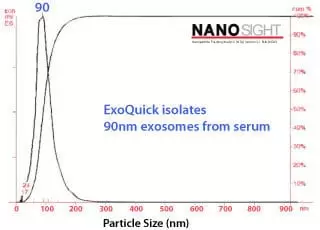
Figure 4. Exosome size distribution and yields from serum. Exosomes were purified from 50 pooled samples of normal human serum. 250 µl of serum was combined with 63 µl of ExoQuick, incubated at 4°C for thirty minutes, and pelleted by a 1500g spin for thirty minutes. The exosome pellet was resuspended in 100 µl of PBS, diluted 1:10,000, and visualized on the NanoSight LM10 instrument. The analysis shows that the ExoQuick isolation method recovered 90 nm exosomes at a concentration of of 2.74 x 10¹² particles/ml.
Any Questions Left?
Contact us for assistance to get started with your gentle and reliable exosome precipitation.
Product Citations
- Ai, JH;Wen, YZ;Dai, SJ;Zhang, LD;Huang, ZJ;Shi, J; (2024) Exosomal lncRNA HEIH, an essential communicator for hepatocellular carcinoma cells and macrophage M2 polarization through the miR-98-5p/STAT3 axis Journal of biochemical and molecular toxicology
- Al Abdullah, S;Cocklereece, I;Dellinger, K; (2024) Unlocking the potential of circulating small extracellular vesicles in neurodegenerative disease through targeted biomarkers and advancements in biosensing Exploration of BioMat-X
- Allen, M;Johnson, B;Kumar, A;Su, Y;Singh, S;Deep, G;Nader, M; (2024) Behavioral and neuronal extracellular vesicle biomarkers associated with nicotine's enhancement of the reinforcing strength of cocaine in female and male monkeys Addiction Neuroscience
- Aoki, S;Inoue, Y;Hara, S;Itou, J;Shirasuna, K;Iwata, H; (2024) microRNAs associated with the quality of follicular fluids affect oocyte and early embryonic development Reproductive medicine and biology
- Arredondo-Damián, JG;Martínez-Soto, JM;Molina-Pelayo, FA;Soto-Guzmán, JA;Castro-Sánchez, L;López-Soto, LF;Candia-Plata, MDC; (2024) Systematic review and bioinformatics analysis of plasma and serum extracellular vesicles proteome in type 2 diabetes Heliyon
- Price
- Please inquire
