
myBaits 16S-Hyb Panel
Analyze microbial communities using amplicon-free targeted sequencing of the total 16S rRNA gene
Product Description
- Use the same NGS library preparation or protocol for shotgun sequencing
- Identify rare taxa in metagenomic samples with less sequence depth
- Avoids issues associated with amplicon-based approaches
- All constant and hypervariable regions are represented
- Compatible with any NGS library platform, including long-read sequencing
- Kits include all necessary reagents to perform enrichment of NGS libraries
The myBaits® 16S-Hyb Panel enriches the entire gene, rather than just one or two hypervariable regions, leading to better taxonomic resolution and less bias than 16S amplicon sequencing. The panel can also efficiently identify rare taxa that may be contributing to novel phenotypes in conjunction with metagenomic studies, requiring less sequence depth for individual samples. Achieve improved characterization of microbial populations in metagenomic samples with a more cost-effective manner compared to shotgun sequencing alone, and more accurately than 16S amplicon sequencing, by combining 16S-Hyb rRNA gene enrichment with low-coverage shotgun sequencing.
Performance Data
The myBaits 16S panel was compared to 16S amplicon and shotgun metagenomic sequencing for samples obtained from a mock community, mouse feces, and rat colon. The unenriched metagenomic sequences contained ~0.1-0.2% 16S reads; enrichment led to a 350-fold enrichment for the mock communities and 450-fold enrichment for the mouse feces and rat colon, with 60-70% of reads on target. Overall, the profile of the enriched samples using either MiSeq or HiSeq sequencing much more closely resembled the mock and shotgun profiles versus the amplicon data in all experiments.
BEI Resources Mock Community Analysis
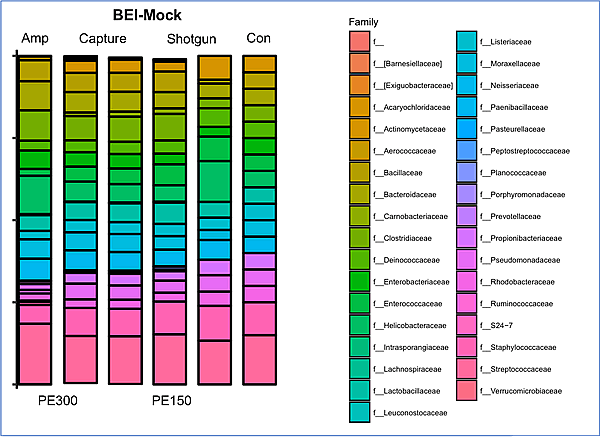
Figure 1.The BEI Resources mock community contains a bacterial population of known content (Column 5) and was analyzed by 16S amplicon sequencing using MiSeq PE 300 (Column 1), myBaits 16S enrichment and sequencing using MiSeq PE 300 (Column 2) or HiSeq PE 150 (Column 3), and shotgun sequencing using HiSeq PE 150 (Column 4). Enriched and unenriched reads were trimmed and filtered, mapped against the GreenGenes database using bbmap, and analysed. Amplicon reads were assessed using the Dada2 pipeline and GreenGenes database.
16S Amplicon vs 16S-Hyb vs Whole Shotgun Sequencing
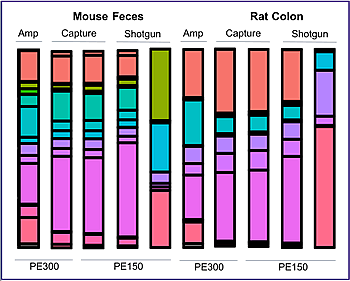
Figure 2. DNA extracted from mouse feces and rat colon was analyzed by 16S amplicon sequencing using MiSeq PE 300 (Columns 1,5), myBaits 16S enrichment and sequencing using MiSeq PE 300 (Columns 2,6) or HiSeq PE 150 (Columns 3,7), and shotgun sequencing using HiSeq PE 150 (Columns 4,8). Enriched and unenriched reads were trimmed and filtered, mapped against the GreenGenes database using bbmap, and analysed. Amplicon reads were assessed using the Dada2 pipeline and GreenGenes database.
Product Citations
- Megan S. Beaudry, Jincheng Wang, Troy J. Kieran, Jesse Thomas, Natalia J. Bayona-Vásquez, Bei Gao, Alison Devault, Brian Brunelle, Kun Lu, Jia-Sheng Wang, Olin E. Rhodes Jr. and Travis C. Glenn (2021) Improved Microbial Community Characterization of 16S rRNA via Metagenome Hybridization Capture Enrichment Front. Microbiol.
